Once upon a time, there was a little boy who, when it came to bedtime stories, preferred those about stone and memories. While others dream of princes and dragons, he dreamed of the sharp corners of old palaces, the scent of centuries-old dust, and the sound of footsteps echoing off historic staircases. Today, that little boy has stopped daydreaming. He has found his castle. It’s not a castle with towers and moats, but it’s much more than that: it’s located in Piazza Armerina. That handful of noble houses clustered around the Norman bulk of the manor—a place of stories, of dominions, of secret passages. The palace dates back to the 19th century, a century of austere elegance, and spans three floors, with twelve spaces just waiting to become rooms once again. But now it is a sleeping giant, a colossus of limestone and plaster that simply asks to be awakened. The exterior retains a few cracks of pride, a few signs of time that call for careful attention and respectful minor maintenance. But it is inside that the most beautiful transformation takes place: the building is a blank canvas, in need of complete renovation. A profound silence dwells within these spaces, broken only by the rustle of light filtering through the original shutters. The interior and exterior windows and doors—true historical artifacts—are there, intact yet fragile: they require not just restoration, but a choice made with love. The soul of the building, however, is found as you walk up the long arched staircases. They are majestic, austere, and maternal. Each step tells the story of a skirt fluttering up, a furtive step, a child’s run. Ten balconies—five on each level—overlook the first and second floors, and stepping out onto them means looking the castle straight in the face, almost coming face to face with history. From there, that child of long ago saw the dreams of his ancestors. Because that’s the point. Piazza Armerina, as we know, has deep roots: Greek, Roman, Arab, Norman. But for that child, now all grown up, it’s not just a UNESCO site or the Villa del Casale. It’s the voice of his grandmother talking about his great-grandfather, who had a shop nearby; it’s his aunt recounting how the ladies used to go out in fur coats for the patron saint festivals. His ancestors lived in this village; they walked its cobblestones and breathed its air, heavy with the scent of sulfur and bread. And now he, with his heart set on the task, wants to give something back to that chain of memories. The project is both simple and monumental: to restore the building to its former glory so it can be lived in, to live out the dream of a lifetime there. Today, the house offers the possibility of creating two bathrooms—essential amenities to breathe new life into a structure from a bygone era. The ground-floor and basement spaces lend themselves to cellars, workshops, and small taverns. There is an inner courtyard, a small cloister waiting to be reinvented, and a secret garden where time can finally stand still. This building isn’t for everyone. It’s for those who aren’t afraid of hard work, dust, or making tough choices. It’s for those who know that restoration doesn’t mean erasing the past, but rather interpreting it. That child, today, looks at the long arches of the staircase and smiles. His grandfather used to tell him, “True dreams have ancient foundations.” And here they are: three floors of possibilities, twelve rooms of the future, and ten balconies from which, every morning—finally home—he’ll be able to say, “The castle is mine.”

 Italiano
  Français
  Español
  Deutsch
  Português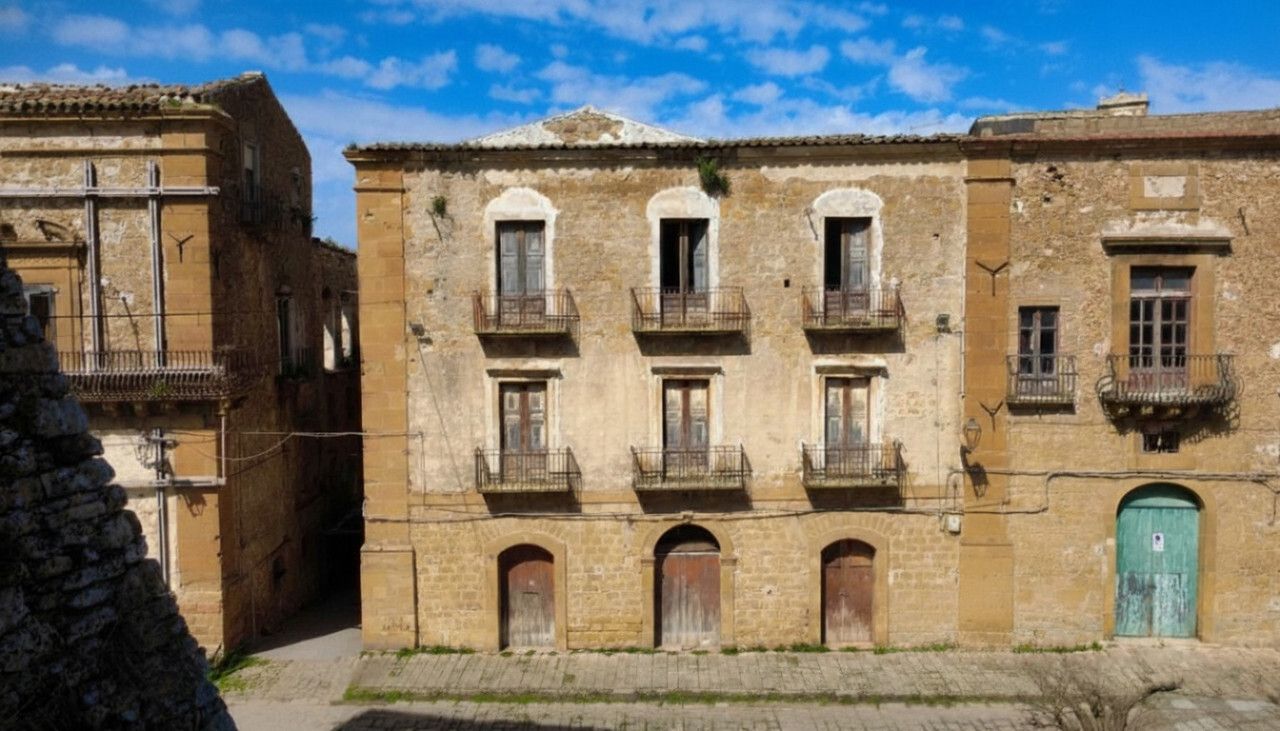


 Teaser


 Piazza Armerina - Sicilia
  Bathrooms: 2
  Internal ref.:
V003252
Internal ref.:
V003252  Sqm:
530
Sqm:
530  Energy class:
-
Energy class:
-  Heating system:
-
Heating system:
-